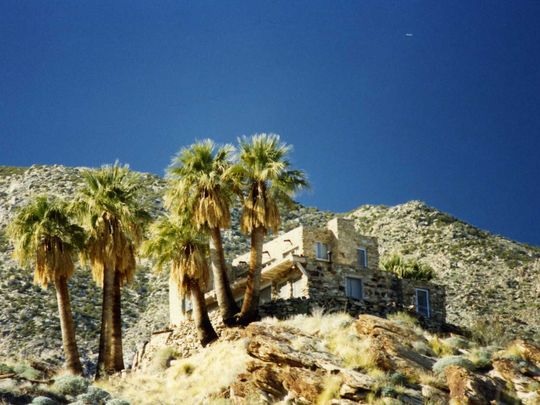
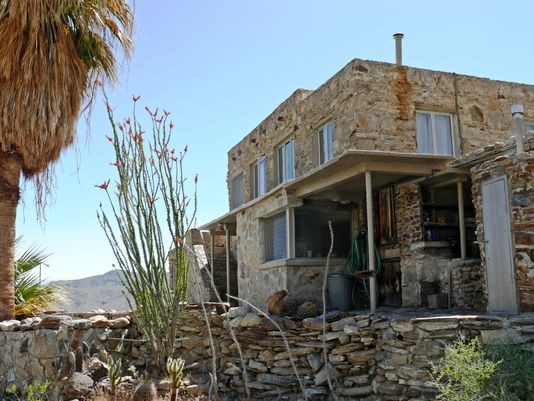
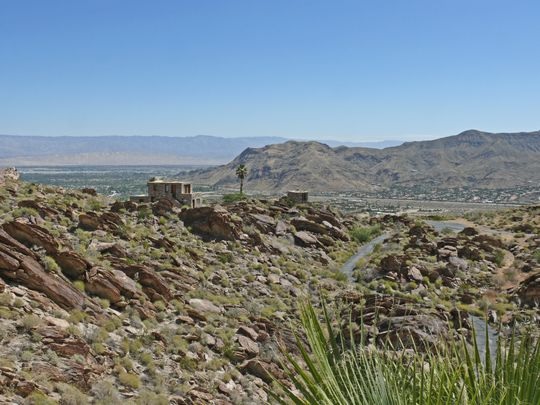
Renee Brown, director of education and associate curator for the Palm Springs Historical Society, recently wrote about the 22 rock houses perched on the walls of Andreas Canyon.
Renee writes that during an early dispute over primary rights to the water coming out of Indian Canyons, an attorney who was working for the Agua Caliente Band of Cahuilla Indians purchased 509 acres of land sitting above the oasis in Andreas Canyon from the tribe. In 1921, he formed the Andreas Club, a private club comprised of 24 members. The members, many of whom were businessmen from the Los Angeles and Long Beach area, had been coming for many years as a group to this area to camp by the stream that winds its way through the canyon. Soon after forming the Andreas Club, the members decided that they wanted to build small cottage like homes and a clubhouse for all of members to enjoy on the property. All of the houses and the clubhouse were built of the rocks that are indigenous to the canyon and restriction were put in place to keep the area as natural as possible. A narrow dirt road, guarded by 2 locked gates, was also built to provide access to the cottages.
Renee also notes that in the early years, propane gas lights were used to illuminate the inside of the cottages. Today generators are used for electricity and propane tanks allow the kitchens to be functional and, in some of the cottages, water to be heated in the rock hot tubs that offer majestic vantage point for views of the valley below. Members still bring in their own supply of water or use water from the nearby creek. No utility lines have been allowed, to keep the environment pristine. There are also club restrictions against killing any animals except rattlesnakes and members enjoy hiking, swimming in the stream and evenings on patios with spectacular views of the entire Coachella Valley. Members and their families usually come to stay during the winter months. Renting or selling these houses is prohibited. If a member dies, the rock house reverts back to the club and the surviving family members can request and must be nominated to become members of the club to retain the right to access the area. Members still do much of the maintenance themselves such as cleaning out clogs in the waterlines.
To read Renee Brown’s original article and view the accompanying photos, courtesy of The Desert Sun and the Palm Springs Historical Society, please visit: http://www.desertsun.com/story/news/2016/09/10/palm-springs-andreas-canyon-agua-caliente-band-of-cahuilla-indians-rock-houses/90099254/